If you have a small kitchen, you already know the struggle. Things pile up fast. A jar gets pushed to the back. Spices multiply. You buy a second bag of flour because you couldn't find the first one. Before long, your pantry feels more like a junk drawer than a cooking space.
The good news? You don't need a bigger kitchen. You need a better system. Color-coded pantry containers are one of the simplest, most effective ways to bring real order to a cramped pantry. They help you see exactly what you have, where it lives, and when it's running low — without opening a single lid.
In this guide, you'll learn why pantry organization matters so much in small kitchens, how color coding actually works, and how to set up a system from scratch. You'll also find practical storage ideas, common mistakes to skip, and the container features worth paying attention to.
 |
A disorganized pantry can make cooking stressful and lead to wasted food and duplicate purchases. |
Why Pantry Organization Matters in Small Kitchens
The Challenges of Limited Pantry Space
Small pantries don't give you much room to work with. When space is tight, overcrowding happens almost automatically. Shelves fill up quickly, and things start to stack in front of each other. The pasta hides behind the canned goods. The oats end up behind the cereal boxes. Suddenly, you can't find anything without rearranging the whole shelf.
Vertical space is another common problem. Most people stack things flat without thinking about height. But a 12-inch shelf with 8-inch items is wasting 4 inches of perfectly good room. That lost space adds up across an entire pantry.
Hard-to-find ingredients create daily frustration too. When everything looks similar — same packaging, same shelf level — your eyes have nowhere to land. You either dig through everything or give up and buy a duplicate item at the store.
How Clutter Impacts Daily Cooking
A messy pantry doesn't just look bad. It costs you money and time.
Food waste is a real consequence of poor organization. When items get buried, they expire before you use them. Yogurt pouches, spice packets, opened boxes of crackers — they all get forgotten when they're not visible.
Duplicate purchases happen for the same reason. If you can't see what you have, you assume you're out. That's how you end up with four bottles of soy sauce or three bags of brown sugar.
Meal prep becomes stressful too. When you're trying to cook something quickly and you can't locate an ingredient, that stress builds up. A well-organized pantry lets you grab what you need and move on.
Benefits of an Organized Pantry
Getting your pantry in order pays off in real, everyday ways.
Better visibility means you can see your ingredients at a glance, even from the doorway. When your pantry is organized by color and category, your brain can process the layout quickly without hunting shelf by shelf.
Cleaning becomes much easier too. Containers with flat sides and uniform shapes wipe down quickly. There's no clutter to move around, no crumbs caught under loose bags.
You also get more efficient storage. Containers stack. Bags don't. An organized pantry fits more food in the same space simply because the shapes work together.
What Are Color-Coded Pantry Containers?
Definition and Purpose
Color-coded pantry containers are storage containers — usually bins, canisters, or baskets — that are sorted by color to represent a specific food category or purpose. Instead of reading a label every time, you use color as a visual shortcut.
 |
Color-coded pantry containers make it easier to identify food categories and maintain organization. |
The goal is simple: make your pantry readable at a glance. Color does that faster than text.
How Color Coding Improves Organization
When every category has its own color, your pantry becomes intuitive. You don't need to think. Green goes here, blue goes there. After a few days, the system becomes second nature.
Color also makes it easy to spot when something is missing. If the green shelf looks thin, you know the healthy snacks are running low. If the yellow row is full, breakfast is covered. You can do a pantry check in seconds.
It also helps other people in the household. Kids, partners, or anyone else cooking in the kitchen can navigate the system without asking questions. That kind of shared clarity is hard to get with text labels alone.
Common Color-Coding Methods
There's no single right way to assign colors. Here are the most popular approaches:
By food category — This is the most common method. One color for grains, another for snacks, another for baking supplies, and so on. It keeps similar foods together and makes cooking prep fast.
By family member — Some families assign each person their own color. This works especially well for snacks, lunchbox items, or allergy-restricted foods. Each person grabs from their color without confusion.
By expiration frequency — Red for things that expire soon, green for long-term staples, yellow for medium-term items. This method helps reduce food waste and keeps rotation visible.
By meal type — Breakfast foods in one color, dinner staples in another, snacks in a third. This makes it easy to shop with purpose and plan meals at a glance.
Best Color-Coding Systems for Pantry Storage
Green Containers for Healthy Snacks
Green is a natural fit for health-focused foods. Assign it to nuts, seeds, dried fruit, granola bars, rice cakes, and other wholesome snacks. The color signal is almost instinctive — green means go, and in this case, it means "reach for something good."
This works especially well if you have kids who like to self-serve snacks. Pointing them to the green shelf removes the guesswork for everyone.
Yellow Containers for Breakfast Foods
Yellow brings a cheerful, morning energy to your pantry shelf. Use it for oats, cereals, pancake mix, granola, and any other breakfast-first ingredients. Clustering breakfast items together also speeds up your morning routine. No scanning multiple shelves — just head to the yellow row.
Blue Containers for Baking Supplies
Blue is calm, cool, and easy to spot. It works well for baking supplies that don't get used every day but need to be findable when you need them. Flour, sugar, baking soda, baking powder, cocoa powder, and vanilla extract all belong in the blue section. Since baking requires specific quantities, using clearly labeled blue containers also helps you track when a staple needs restocking.
Red Containers for Frequently Used Ingredients
Red signals importance and urgency. Use it for your daily go-tos — rice, pasta, lentils, cooking oil, salt, and anything you reach for regularly. Putting your most-used items in the most eye-catching color means they'll always be easy to find and easy to grab quickly.
Neutral Containers for Bulk Storage
Neutral tones — white, beige, clear, or natural wood — are great for bulk items that don't fit neatly into a single category. Think large bags of flour, extra canned goods, or backup supplies that don't need daily attention. Neutral containers give your pantry a clean baseline that lets the other colors stand out.
Labeling Tips for Better Results
Even with a solid color system, labels add an important layer of clarity. Write the name of the food, and consider adding the purchase date or a "use by" note. A simple label maker works great, but even handwritten labels on masking tape do the job. Keep font sizes consistent and place labels at eye level or facing the same direction so scanning the shelf is easy.
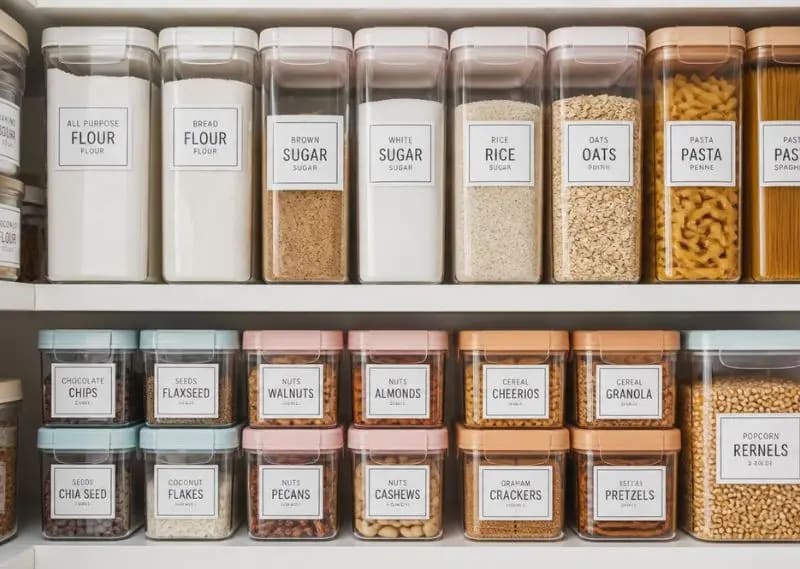 |
Labels work alongside color coding to create a pantry system that is easy to understand and maintain. |
How to Set Up a Color-Coded Pantry Step by Step
Step 1 – Empty and Clean the Pantry
Start by taking everything out. Every item, every shelf. This step feels like extra work, but it's the only way to truly start fresh. Wipe down the shelves and let them dry completely. Getting rid of crumbs, dust, and residue before organizing means you won't be cleaning around clutter later.
While you're at it, check expiration dates. Toss anything that's gone bad and set aside items that are about to expire so you can use them first.
Step 2 – Sort Food by Category
Group your food on a table or counter before putting anything back. Put grains together, snacks together, baking supplies together. This gives you a clear picture of what you actually have, how much of it there is, and what categories dominate your pantry. It also makes it easier to decide how many containers you need for each group.
 |
Sorting food into categories is the first step toward creating an efficient pantry organization system. |
Step 3 – Choose Matching Containers
Once you know your categories, choose containers to match. Look for a consistent size system — for example, large containers for bulk staples, medium for everyday items, and small for specialty ingredients or spices. Stick to one brand if possible so the shapes stack and line up cleanly.
Pick your color assignments at this stage so you can shop smart and avoid buying containers that don't match your plan.
 |
Stackable containers help small kitchens use vertical storage space more efficiently. |
Step 4 – Assign Colors Strategically
Think about how often you use each category, and assign colors based on visibility. Most-used categories like daily staples should get the most eye-catching color (red works well). Less-used categories like baking supplies can go in cooler colors like blue or neutral.
You don't need a color for every single item. Five or six colors is plenty for most pantries. Keeping the system simple makes it easier to maintain.
Step 5 – Add Labels
Label every container before it goes back on the shelf. Include the food name and, if it matters, the fill date or expiration window. Use a consistent label style so the shelf looks clean and readable.
Clear, simple labels are better than decorative ones. The goal is to read them fast, not admire them.
Step 6 – Arrange for Easy Access
Put the most-used items at eye level. Heavy or infrequently used items go on lower shelves. Lighter, rarely needed things go up top. Arrange containers with the labels facing forward so you can read them without moving anything.
Group your colors together by shelf so the system makes visual sense: one shelf for breakfast items, one for snacks, one for cooking staples.
Small Kitchen Pantry Storage Ideas Using Color-Coded Containers
Vertical Shelf Organization
Think in layers. Instead of spreading items across a shelf, use tiered shelf risers to add a second level. This lets you see canisters in the back row just as clearly as those in front. In a small pantry, using vertical space this way can effectively double your visible storage.
 |
Shelf risers help maximize vertical pantry storage without requiring additional square footage. |
Stackable Container Systems
Stackable containers are a game-changer in tight spaces. When containers are the same brand and shape, they stack cleanly without shifting or tipping. You can build upward instead of outward, which is exactly what a small pantry needs. Just make sure the stacks don't get too tall to reach safely.
Corner Pantry Solutions
Corner shelves are often the most neglected spots in a pantry. Use lazy Susans or rotating turntables in corners to bring back-row containers to the front with a simple spin. Lazy Susans work especially well for small jars, spice containers, and condiments.
 |
A Lazy Susan makes corner pantry storage more accessible and easier to maintain. |
Deep Shelf Storage Tricks
Deep shelves tend to swallow things whole. The back gets ignored, and the front gets cluttered. A simple fix is to use two rows of containers with a shelf riser elevating the back row. This way you can see and reach both rows without digging. Pull-out shelf drawers are another great option for very deep shelves.
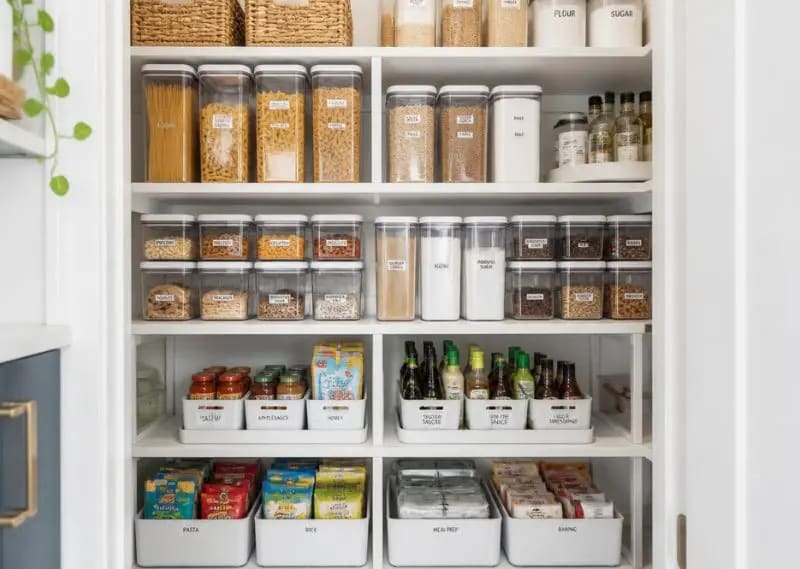 |
Proper organization prevents deep pantry shelves from becoming cluttered and difficult to use. |
Cabinet Pantry Organization
If your pantry is inside a cabinet rather than a dedicated closet, use the door too. Over-door organizers with bins or pockets are perfect for small, lightweight items like spice packets, tea bags, and seasoning blends. Inside the cabinet, stack containers by category and keep the tallest ones in the back corners where they won't block visibility.
Open Shelf Pantry Displays
Open shelving turns your pantry into a visible, intentional display. When your containers are color-coordinated and neatly arranged, they actually look good. This setup works beautifully in small kitchens where open shelving is the only option. Keep containers clean, keep labels forward, and maintain consistent spacing for a result that's both practical and polished.
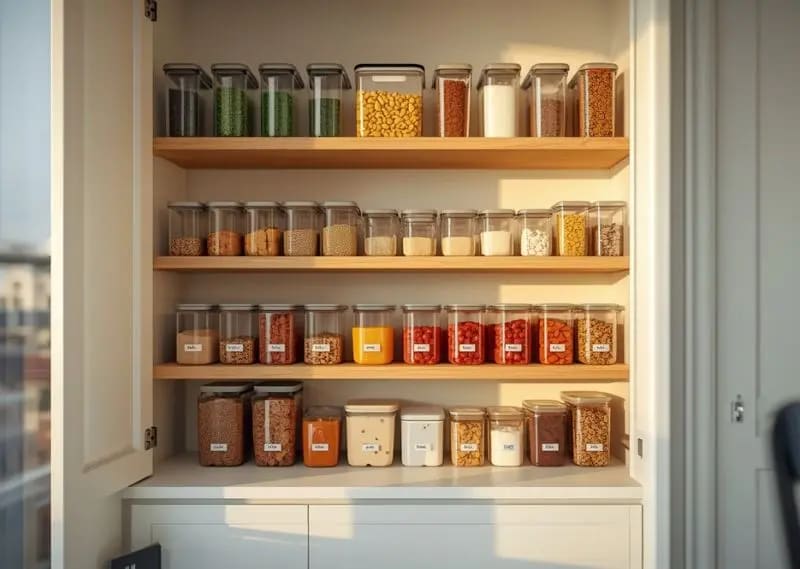 |
An organized open-shelf pantry combines practical storage with attractive kitchen styling. |
Common Pantry Organization Mistakes to Avoid
Using Too Many Colors
More colors doesn't mean more organized. If you assign eight or ten different colors to different categories, the system becomes harder to remember than just reading labels. Keep it simple — five or six colors is a manageable, memorable system.
Ignoring Labels
Color is a shortcut, but it's not a complete system. Without labels, you'll still open containers trying to remember what's inside. Labels take two minutes per container and save you significant frustration over time. Don't skip them.
Buying Containers Before Measuring
This one is easy to overlook. Containers that are too tall, too wide, or too deep won't fit your shelves. Always measure your shelf height and depth before shopping. Also consider the width of your pantry door — some deep containers won't clear it when the door opens.
Overfilling Containers
A container that's crammed to the top is harder to close, harder to pour from, and harder to see into. Fill containers to about three-quarters of their capacity to leave room for easy access and air circulation for dry goods.
Mixing Different Organization Systems
Switching between a category system and a meal-type system mid-pantry creates confusion. Pick one logic for your color coding and apply it consistently throughout the whole pantry. Mixing systems makes the whole thing harder to follow.
Essential Features to Look for in Pantry Containers
Airtight Lids
Airtight lids keep moisture, pests, and air away from your food. This matters especially for flour, sugar, rice, nuts, and cereals. Look for lids with silicone seals or locking clips for the best seal. A container that doesn't seal properly is just a decorative bowl.
Stackable Design
Flat-top lids and consistent container heights let you stack without wobbling. Square or rectangular containers stack more efficiently than round ones because they use every inch of shelf space without leaving gaps.
Clear Visibility
Even with color coding, being able to see the contents matters. Clear or translucent containers let you check fill levels without opening the lid. This is especially useful for grains, pasta, and snacks where you want to monitor when you're running low.
Durable Materials
Look for BPA-free plastic or borosilicate glass for food-safe durability. Plastic is lighter and less likely to break when dropped. Glass is heavier but more resistant to staining and odors. Either works — just choose based on what you use the container for and how often you handle it.
Easy-to-Clean Construction
Wide-mouth openings are easier to clean than narrow ones. Smooth interiors without ridges or grooves don't trap crumbs. Dishwasher-safe containers save time. If a container is hard to clean, it's hard to maintain — and maintenance is the key to keeping any organization system working.
Frequently Asked Questions
Are color-coded pantry containers worth it?
Yes, especially in a small kitchen. The upfront cost is quickly offset by less food waste, fewer duplicate purchases, and a genuinely easier time cooking. Once the system is set up, maintaining it takes almost no effort.
What colors work best for pantry organization?
There's no universal right answer, but high-contrast, distinct colors work best. Red, yellow, green, blue, and white are easy to tell apart at a glance. Avoid colors that look too similar next to each other, like navy and dark green, or pale yellow and cream.
How many container colors should I use?
Three to six colors is the sweet spot for most pantries. Fewer than three and you're not really color coding — you're just storing things. More than six and the system becomes harder to remember and visually noisy.
Can color coding work in very small kitchens?
Absolutely. In fact, small kitchens benefit the most from this kind of system. When you have limited shelf space, being able to see and grab exactly what you need in seconds is especially valuable. Start small — even two or three color categories make a meaningful difference.
Do I still need labels if containers are color-coded?
Yes. Color tells you the category. Labels tell you what's specifically inside. Together, they make a complete and reliable system. Think of color as the neighborhood and the label as the street address.
 |
A well-planned color-coded pantry creates a cleaner, more functional kitchen with less daily stress. |
Conclusion
A small kitchen doesn't have to feel chaotic. With the right system in place, even a compact pantry can be calm, functional, and easy to work in every day.
Color-coded pantry containers give you a visual language that replaces the confusion of mismatched packaging and overcrowded shelves. Each color becomes a signal — and over time, that signal becomes automatic. You stop hunting and start cooking.
The best part is that you don't need to overhaul everything at once. Start with just two or three color categories. Pick the ones that cause you the most daily frustration, assign a container, and build from there. Small steps done consistently lead to a pantry that stays organized long after the initial effort is done.
The goal isn't a perfect pantry. It's a pantry that works for you — one you can keep up with, one that saves you time, and one that makes cooking feel easier than it did before.
🌿 Outdoor Living & Landscaping Ideas
• 25 Stunning Landscaping Ideas for Your Lawn & Garden (Backyard, Patio & Outdoor Spaces 2026)
• 25 Pool Designs That Will Transform Your Backyard in 2026 (Luxury to Budget Ideas)
• 30 Cozy Patio Decor Ideas: Create a Relaxing Outdoor Oasis at Home
• 15 Best Furniture Sets for Every Space: Patio, Living Room, Bedroom & Outdoor Living
🛋️ Living Room & Small Space Design
• Transform Your Space: Best Floor Lamps for Living Room in 2026
• 15 Best Sofas for Small Living Rooms That Maximize Space & Style
• Best Space Saving Furniture for Living Room in 2026 for Small Apartments
• Small Room? These Cozy Corner Ideas Will Completely Change How It Feels
🛏️ Bedroom Decor & Organization
• Aesthetic Bedroom Ideas for Small Rooms: Dreamy & Cozy Decor Guide
• Floating Shelves for Bedroom: Best Picks + Stylish Ideas (2025 Guide)
• Small Bedroom Ideas for 2026: Maximize Style & Space
• 10 Bedroom Wall Decor Ideas for Small Rooms (Budget-Friendly & Modern 2026)
• 20 Best Wall Decor Ideas for Bedroom Walls (Stylish & Easy Upgrades)
• 5 Boho Bedroom Wall Décor Ideas for 2026
• Tired of Your Bedding Letting You Down? Meet Your Dream All-Season Solution.
🏡 Home Decor & Interior Inspiration
• 20 Japandi Interiors That Perfectly Blend Scandinavian Simplicity & Japanese Elegance
• 23 Iranian Home Decor Interior Design Ideas That Bring Timeless Elegance
• 21 Artificial Flora for Home Decor (Stylish, Low-Maintenance Greenery for Every Room)
• 10 Stylish Neutral Home Office Designs for Men That Boost Focus and Comfort
🧺 Home Organization & Smart Storage
• Ultimate Home Organization Guide for Beginners (2026)
• 7 Genius Storage Tricks That Double Your Toddler's Floor Space
🛁 Bathroom & Seasonal Decor
• 7 Bathroom Remodel Design Ideas to Transform Your Space in 2026
• 7 Valentine Home Décor Ideas to Create a Romantic, Cozy & Pinterest-Worthy Space
• Top 5 Valentine’s Day Home Decor Ideas to Create a Romantic Atmosphere


0 Comments