Introduction
You wake up with fifteen minutes to spare. You open your closet, and suddenly the morning spirals. You cannot find your favorite shirt. Your shoes are buried somewhere in the back. That one blazer you need is wrinkled under a pile of things you have not touched in months. By the time you leave the house, you are frustrated before the day has even started.
 |
A messy closet creates morning stress and wastes valuable time before your day even starts |
Sound familiar? A messy closet is not just a visual problem. It costs you time, energy, and mental peace every single day. Most people underestimate how much a disorganized wardrobe quietly drains them.
The good news is that fixing it does not require a massive budget or a complete renovation. You just need the right closet organization ideas, a clear plan, and a little consistency.
In this guide, you will learn a step-by-step approach that covers everything — from decluttering your wardrobe the smart way, to setting up functional storage zones, using space-saving hacks, and building habits that keep your closet neat long term. Whether you have a large walk-in or a tiny apartment closet, these tips work for any space and any lifestyle.
Let us get started.
Why Closet Organization Matters
Before jumping into the how-to part, it helps to understand why a well-organized closet actually changes your daily life. This is not just about aesthetics.
Mental Clarity and Productivity
Visual clutter creates mental clutter. When you open your closet and see chaos, your brain registers it as unfinished business. Studies on environmental psychology consistently show that disorganized spaces raise cortisol levels and increase feelings of stress and anxiety.
A tidy closet, on the other hand, gives you one less thing to worry about. When your clothes are arranged clearly, choosing an outfit becomes fast and almost effortless. Better decisions in the morning often lead to a calmer, more productive rest of the day.
Saves Time Every Day
Think about how many minutes you lose every week searching for things. A shirt that should take five seconds to grab ends up costing you five minutes of digging. Multiply that across a year, and you have lost hours — maybe days — to a disorganized wardrobe.
Good closet organization puts your most-used items exactly where your eyes and hands naturally go. Your mornings become smoother, and your routine feels less rushed.
Protects Your Clothes
Overcrowded closets damage clothing. Hangers get too tightly packed and leave permanent creases. Shoes stacked carelessly lose their shape. Sweaters folded under heavy items get stretched and misshapen. A properly organized closet gives every item enough space, which means your clothes last longer and look better when you wear them.
Maximizes Small Spaces
If you live in an apartment or share a room, space is a real constraint. Smart closet organization is not a luxury for people with walk-in closets. It is actually most important for small spaces. With the right setup, even the tiniest closet can hold a surprising amount while staying completely accessible.
Step 1: Declutter Before You Organize
This is the rule most people skip, and it is exactly why their organization efforts never stick. You cannot organize clutter. Before you buy a single shelf, bin, or hanger, you have to reduce what is in your closet.
The "Keep, Donate, Discard" Method
Get three boxes or bags and label them: Keep, Donate, and Discard. Then pull everything out of your closet — yes, everything — and sort each item into one of those three categories.
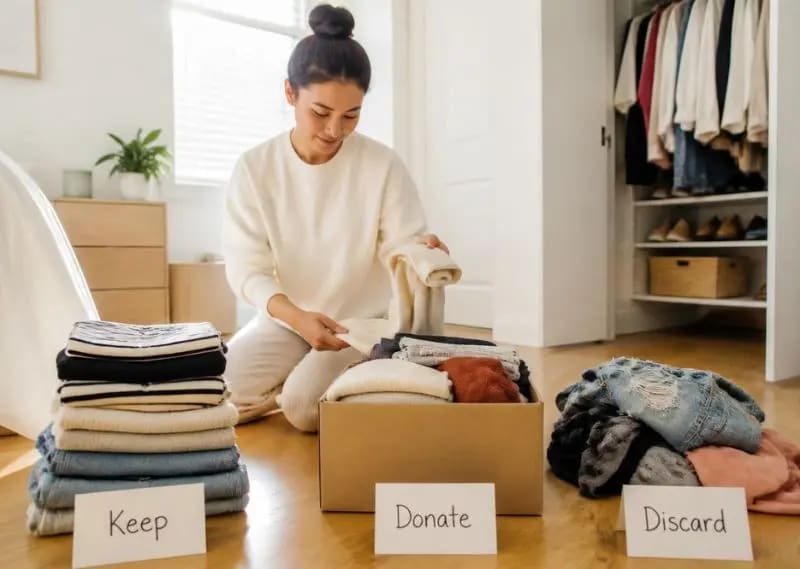 |
The keep donate discard method simplifies decluttering and helps create a more organized closet system |
The key here is to make practical decisions, not emotional ones. Many people hold onto clothes because of sentiment, guilt, or the hope that they will wear them someday. That "someday" rarely comes. Ask yourself honestly: Do I wear this? Does it fit? Does it make me feel good? If the answer is no to more than one of those questions, it does not belong in the Keep pile.
Donated items go to someone who will actually use them. Discarded items are things too worn or damaged to pass on.
Seasonal Rotation Strategy
Not everything needs to be in your closet at the same time. Summer clothes do not need to take up space in December, and heavy winter coats do not need to hang through July. Store out-of-season clothing in labeled bins, under the bed, or in a separate storage area.
A good habit is to rotate your wardrobe twice a year — once in spring to bring out lighter clothes, and once in autumn to shift back to warmer layers. This alone can free up thirty to forty percent of your closet space.
The Rule of Unused Items
If you have not worn something in six to twelve months and it is not a special occasion item, it is time to let it go. This one rule, applied consistently, prevents your closet from slowly filling back up with things that do not serve you. Be honest. Be practical. Your future self will thank you.
Step 2: Smart Closet Zone Setup
Once your closet holds only what you actually use and love, the next step is organizing it into functional zones. This is what separates a closet that looks good for a week from one that stays neat all year.
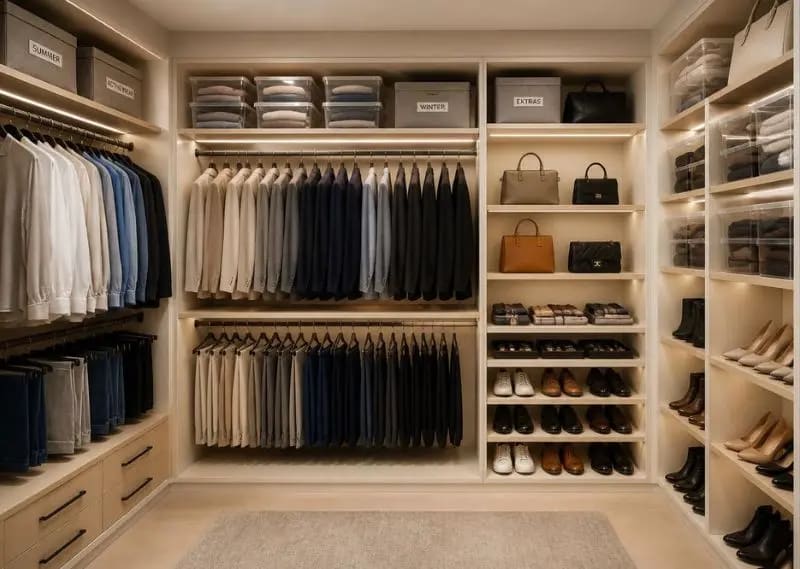 |
Closet zoning creates structure and makes outfit selection faster and more efficient every day |
Divide Your Closet Into Functional Zones
Think of your closet like a small store. Every category of item should have its own dedicated section. A practical zone setup might look like this:
- Daily wear zone — Everyday clothes you reach for constantly
- Work or formal zone — Office wear, formal outfits, dress clothes
- Seasonal storage — Items currently out of season
- Accessories zone — Belts, scarves, jewelry, bags, and shoes
When every category has a home, things go back where they belong naturally. You stop losing items because you always know exactly where to look.
Eye-Level Priority Rule
Your most-used items should sit at eye level. This is the prime real estate in your closet. Everything you grab on a daily or weekly basis — your go-to jeans, your everyday shirts, your work basics — should live here.
Items you use less often, like formal wear or off-season pieces, go higher up or toward the bottom. This simple hierarchy makes your most-used items instantly visible and accessible without any digging.
Flow-Based Organization
Think about your actual morning routine and design your closet around it. If you always grab your top first, then pants, then shoes, arrange them in that natural sequence. When your closet layout mirrors the way you actually move through getting dressed, using it becomes intuitive rather than effortful.
Step 3: Space-Saving Storage Hacks
Now for the practical tools and tricks. These closet organization tips make a real difference, especially when you are working with limited space.
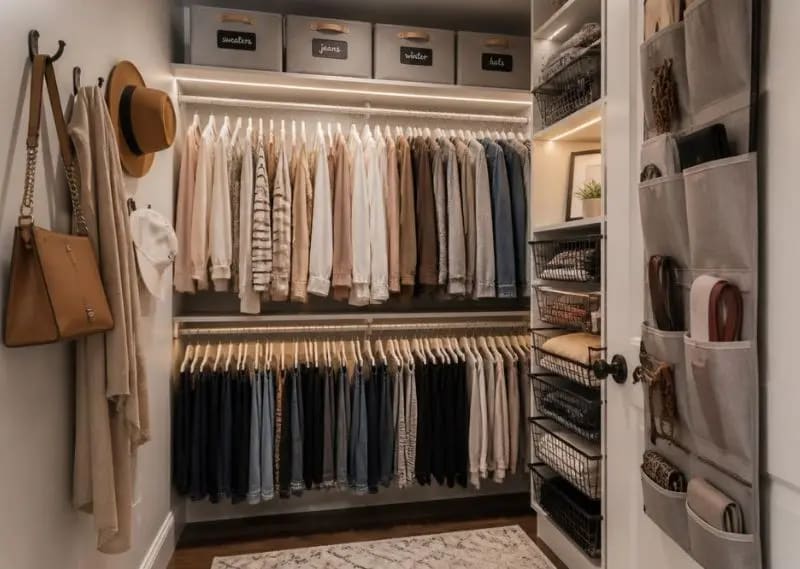 |
Vertical storage hacks instantly double your closet capacity without needing extra space |
Use Vertical Space Effectively
Most people use only the horizontal space in a closet and ignore the height completely. Installing a second hanging rod below your main one instantly doubles your hanging capacity. Stackable shelves let you build upward instead of outward. Do not let the top of your closet sit empty — use it for labeled bins and boxes that hold seasonal items or rarely used things.
Slim Hangers vs Bulky Hangers
Switching from thick plastic hangers to slim velvet hangers is one of the easiest upgrades you can make. Velvet hangers take up a fraction of the space, keep clothes from sliding off, and make your entire hanging section look uniform and clean. It is a small change with a surprisingly large visual and functional impact.
Storage Boxes and Bins
Bins and boxes are essential for organizing items that cannot be hung — folded sweaters, accessories, shoes, bags, and seasonal pieces. The most important habit here is labeling. Every bin should have a clear label so you know what is inside without opening it.
Transparent bins are great for items you need to find quickly. Opaque bins with labels work well for seasonal storage or items you do not access often. Use consistent sizing where possible so your shelves look neat and stack easily.
Door and Wall Storage
The back of a closet door is often completely ignored. A hanging shoe organizer, a pocket organizer, or a row of hooks on the back of the door can hold an enormous amount — scarves, belts, small bags, cleaning supplies, or folded items. Wall-mounted hooks inside the closet are equally useful for bags, hats, or frequently worn outer layers.
Under-Shelf Utilization
Hanging baskets that clip under existing shelves give you extra storage space without any installation. Add-on shelves that slide onto existing rods can double the usable surface area. Every inch of underused space is a storage opportunity.
Step 4: Folding and Hanging Techniques
How you fold and hang your clothes is just as important as where you put them.
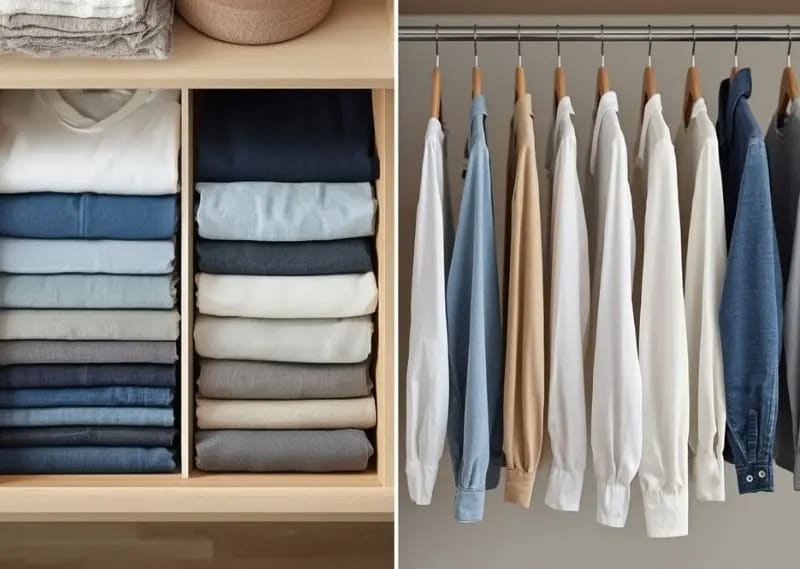 |
Proper folding and hanging systems keep every item visible and prevent hidden clutter |
The Marie Kondo Folding Method
Marie Kondo's vertical folding technique is one of the most well-known closet organization tips for a reason — it genuinely works. Instead of stacking clothes horizontally in drawers, you fold them into small rectangles and stand them upright, side by side, like files in a cabinet.
The benefit is that you can see every single item at a glance without disturbing the rest. Nothing gets buried. Nothing gets forgotten. Your drawers become easy to navigate, and everything stays visible and accessible.
Hanging System Rules
As a general guideline, hang items that wrinkle easily or lose their shape when folded — dress shirts, blouses, trousers, jackets, and dresses. Fold items that are better stored flat — knitwear, T-shirts, jeans, and casual loungewear.
Avoid overcrowding your hanging rail. Clothes need a little breathing room to stay wrinkle-free and accessible. If you have to force hangers apart to get to something, that section is too full.
Categorized Grouping
Within each zone, group items by category first, then by color within that category. Color grouping makes finding a specific item much faster and gives your closet a visually clean, intentional look. Some people also group by fabric type, which helps with care and maintenance.
Step 5: Accessories and Small Item Organization
Small items create the biggest mess when they have no system. Here is how to handle them.
Jewelry Organization Ideas
Tangled necklaces and misplaced earrings are a daily frustration. Drawer trays with individual compartments keep small jewelry pieces separated and easy to find. For necklaces and bracelets, a hanging organizer with hooks keeps everything visible and tangle-free. If wall space allows, a mounted jewelry display can turn your accessories into part of your room decor.
Belt, Scarf, and Tie Storage
Dedicated hooks or a small rotating rack handle belts and ties beautifully. Scarves can be folded and stored in a drawer with dividers, or looped through a hanging organizer. The goal is to give these items a specific home so they stop collecting in random corners.
Bags and Shoes System
Bags should be stored upright on shelves, not stuffed into corners. Use shelf dividers to keep them standing and separated. For delicate bags, consider a dust bag or pillowcase to protect them.
Shoes work best on dedicated shoe shelves or racks that keep each pair visible and paired together. Storing shoes in their original boxes with a photo on the front is another great option if shelf space is limited. Clear shoe boxes are ideal — you can see the contents without opening them.
Step 6: Maintaining a Neat Closet Daily
Getting your closet organized is one thing. Keeping it that way is where most people fall short. The key is building small, sustainable habits.
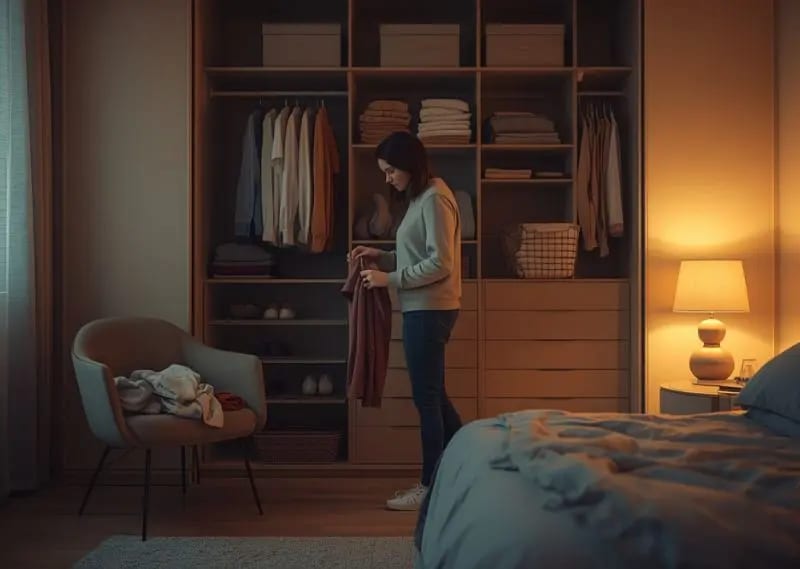 |
A 5-minute daily reset keeps your closet organized and prevents clutter from building up again |
The 5-Minute Reset Habit
At the end of each day — or first thing in the morning — spend five minutes returning anything out of place to where it belongs. Rehang the jacket you tossed on the chair. Put the shoes back on the shelf. Return the belt to its hook. This tiny daily reset prevents small mess from building into a big one.
The One-In, One-Out Rule
Every time you bring a new item into your closet, something else should leave. Buy a new shirt? Donate one you no longer wear. Get a new pair of shoes? Remove a pair you have not worn in months. This rule keeps the total volume of your wardrobe steady and prevents the slow creep of overcrowding.
Weekly Mini Audit
Once a week, take a quick look through your closet. Notice anything that does not belong, anything that has been sitting untouched, or anything that needs to be returned to its proper place. This five-minute check keeps small disorganization from becoming a big problem.
Common Closet Mistakes to Avoid
Even with the best intentions, certain habits will undo your hard work quickly. Watch out for these:
- Overstuffing hangers — Clothes cannot breathe and wrinkles form fast
- Ignoring vertical space — You are leaving usable storage completely empty
- Keeping "just in case" clothes — If you have not needed it in a year, you probably will not
- No labeling system — Bins and boxes without labels become mystery piles
- Mixing categories randomly — When things have no designated home, they end up everywhere
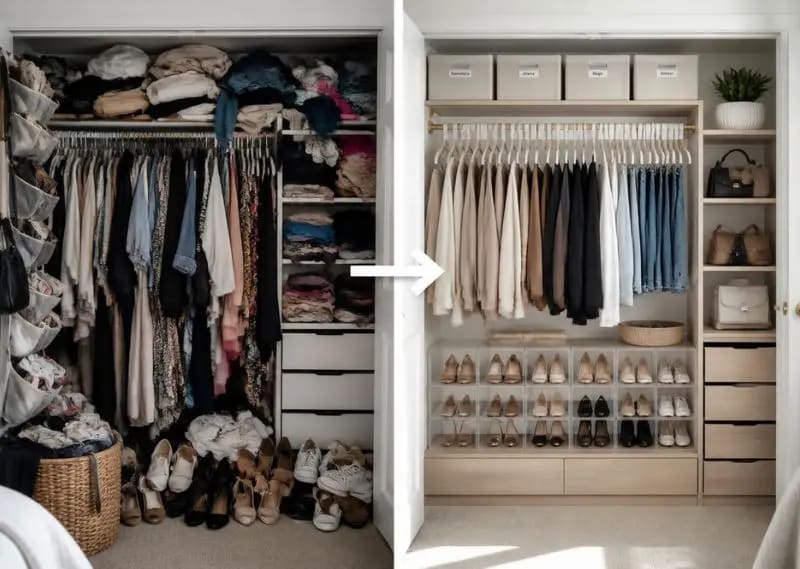 |
Avoid common closet mistakes like overcrowding and poor labeling to maintain long-term organization success
Avoiding these five mistakes alone will make a significant difference in how functional and lasting your closet organization stays.
Conclusion
A well-organized closet is not about being a minimalist or having the fanciest storage system. It is about making your everyday life a little easier, a little calmer, and a lot more efficient. The closet organization ideas in this guide are practical, low-cost, and designed to work in any size space.
Start with decluttering — that step alone creates more breathing room than any storage product can. Then set up your zones, bring in the right tools, build your folding and hanging habits, and commit to the small daily routines that keep everything in place.
You do not have to overhaul everything in one afternoon. Even choosing one or two strategies from this guide and applying them consistently will create a noticeable shift. Small changes, done regularly, lead to lasting transformation.
The best time to start is today. Pull out those three boxes, label them, and begin. Your future morning self will be very glad you did.
🌿 Outdoor Living & Landscaping Ideas
• 25 Stunning Landscaping Ideas for Your Lawn & Garden (Backyard, Patio & Outdoor Spaces 2026)
• 25 Pool Designs That Will Transform Your Backyard in 2026 (Luxury to Budget Ideas)
• 30 Cozy Patio Decor Ideas: Create a Relaxing Outdoor Oasis at Home
• 15 Best Furniture Sets for Every Space: Patio, Living Room, Bedroom & Outdoor Living
🛋️ Living Room & Small Space Design
• Transform Your Space: Best Floor Lamps for Living Room in 2026
• 15 Best Sofas for Small Living Rooms That Maximize Space & Style
• Best Space Saving Furniture for Living Room in 2026 for Small Apartments
• Small Room? These Cozy Corner Ideas Will Completely Change How It Feels
🛏️ Bedroom Decor & Organization
• Aesthetic Bedroom Ideas for Small Rooms: Dreamy & Cozy Decor Guide
• Floating Shelves for Bedroom: Best Picks + Stylish Ideas (2025 Guide)
• Small Bedroom Ideas for 2026: Maximize Style & Space
• 10 Bedroom Wall Decor Ideas for Small Rooms (Budget-Friendly & Modern 2026)
• 20 Best Wall Decor Ideas for Bedroom Walls (Stylish & Easy Upgrades)
• 5 Boho Bedroom Wall Décor Ideas for 2026
• Tired of Your Bedding Letting You Down? Meet Your Dream All-Season Solution.
🏡 Home Decor & Interior Inspiration
• 20 Japandi Interiors That Perfectly Blend Scandinavian Simplicity & Japanese Elegance
• 23 Iranian Home Decor Interior Design Ideas That Bring Timeless Elegance
• 21 Artificial Flora for Home Decor (Stylish, Low-Maintenance Greenery for Every Room)
• 10 Stylish Neutral Home Office Designs for Men That Boost Focus and Comfort
🧺 Home Organization & Smart Storage
• Ultimate Home Organization Guide for Beginners (2026)
• 7 Genius Storage Tricks That Double Your Toddler's Floor Space
🛁 Bathroom & Seasonal Decor
• 7 Bathroom Remodel Design Ideas to Transform Your Space in 2026
• 7 Valentine Home Décor Ideas to Create a Romantic, Cozy & Pinterest-Worthy Space
• Top 5 Valentine’s Day Home Decor Ideas to Create a Romantic Atmosphere


0 Comments